
Highlights
Understanding User Identification in Virtual Reality Through Behavioral Biometrics and the Effect of Body Normalization
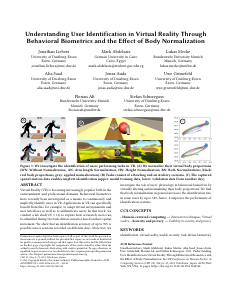
Virtual Reality (VR) is becoming increasingly popular both in the entertainment and professional domains. Behavioral biometrics have recently been investigated as a means to continuously and implicitly identify users in VR. Applications in VR can specifically benefit from this, for example, to adapt virtual environments and user interfaces as well as to authenticate users. In this work, we conduct a lab study (N = 16) to explore how accurately users can be identified during two task-driven scenarios based on their spatial movement. We show that an identification accuracy of up to 90% is possible across sessions recorded on different days. Moreover, we investigate the role of users’ physiology in behavioral biometrics by virtually altering and normalizing their body proportions. We find that body normalization in general increases the identification rate, in some cases by up to 38%; hence, it improves the performance of identification systems.