
Successfully Defended My Dissertation
Today, I successfully defended my dissertation, titled Behavioral Biometrics in Extended Reality: Implicit User Authentication Through Artificial Intelligence, at the University of Duisburg-Essen. I am deeply grateful that my dissertation was awarded summa cum laude.
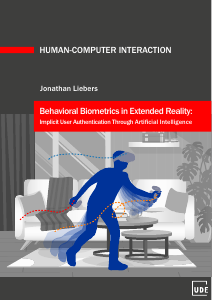
As extended reality (XR) systems become more widely used, it becomes more and more important to employ usable authentication mechanisms. Previous work has shown that conventional methods such as PINs and passwords are cumbersome in virtual environments and may be prone to bystanders’ observation. My work therefore explores a different approach: identifying users implicitly and continuously through their spatiotemporal body movements and interactions.
Across six empirical studies, we investigated which aspects of human behavior can serve as reliable biometric signals and which factors influence recognition performance. These include movement components, physiological characteristics, colocated interactions, changes over time, gaze and head behavior, and fine-grained hand and finger movements. The results show that behavioral biometrics can enable reliable user identification in XR.
The dissertation is based on my research conducted between 2020 and 2025. I am sincerely grateful to everybody who contributed to the underlyign research.
My deepest thanks go to my supervisorreviewer, Prof. Dr. Stefan Schneegaß, for giving me the opportunity to pursue this doctorate and for all the guidance guidance and ideas over the years. I also thank my reviewers, Prof. Dr. Florian Alt and Prof. Dr. Antonio Krüger, for their time and thoughtful assessmentk. I am equally grateful to Prof. Dr. Gregor Schiele and Prof. Dr. Volker Gruhn for serving on and chairing the examination committee.
The dissertation is available open access through DuEPublico.